![]() |
![]() |
![]() |
Join our newsletter!

Current Promotions
Click Here for our latest specials.
Home > Line
Blowing > Power Blower
![]() |
Power Blower 58400 series Catalog PDF Specifications |
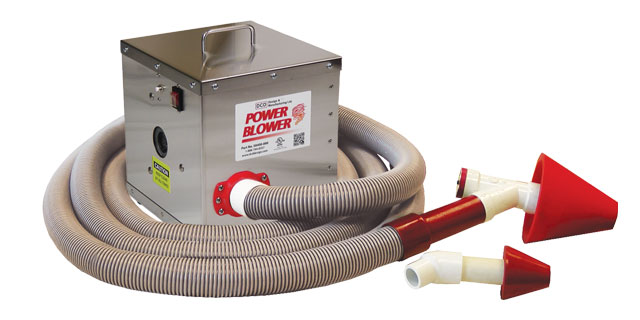
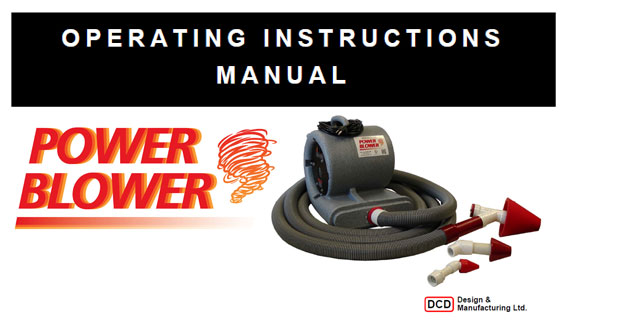
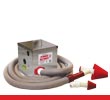
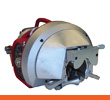
DCD offers a unique portable Power Line Blower. While there
are several other similar products on the market, the DCD unit offers
a higher pressure output along with an excellent list of special features
including:
• A Stainless Steel housing fitted with a rugged powder coated
steel lid and carrying handle that doubles as a coiler for storing
the power cord;
• Certification for outdoor use (not in rain);
• Two 1.8 HP heavy duty electric motors fitted with non-corrosive components
and sealed bearings, each individually fused and delivering up to 225
cfm and 4 psi. The high psi rating allows longer blows, especially
when under load (See below for full explanation).
• An extra heavy duty 25’ long 2" hose made of crush
resistant polyethylene which will stand up in temperatures from –40
to +140 deg F.
• The blowers operate at 110V and require 30 amp source. A220V/110V
is also available.
Although other manufacturers have a higher cfm rating, that will only
increase the speed of the dart – instead of taking 8 seconds
to travel 500 feet, the DCD unit may take a couple of seconds more.
The higher pressure rating is key because this will allow a dart carrying
pull tape or twine to travel further with higher loads, even though
it might take a few seconds longer. (See below for a more detailed
explanation.)
DCD also offers a full line of blowing accessories detailed on the
following pages. The standard Foam Bird types are available as well
as the twin coned Line Darts. A polyurethane Ultralight Bird, not
offered by other manufacturers, is available as well as the standard
Inflatable type for use with product already in the duct. A new Parachute
is also fast becoming a favorite. The Seal-off units are sized to fit
ducting up to 6" and the handle is fitted with a special selector
for different twine or pulling tape sizes.
Understanding Blower Performance
The output of a blower is usually specified in terms of (i) its flow rate (cfm), and (ii) its pressure (psi). The flow rate determines how fast the blower can move a projectile, and the pressure determines how much load the projectile can pull and how far it can pull it.
When a blower is running with an unrestricted outlet, it will produce its maximum specified flow rate because there is no restriction on the outlet and the blower is working against zero psi backpressure.
If the blower is attached to a short length of empty conduit, the air being forced in by the blower tries to move all of the air in the conduit and push it out of the other end. The friction created by the air moving through the conduit causes a backpressure which the blower must overcome. As the blower works against this backpressure, its flow rate drops.
Therefore … a blower can never produce its maximum specified flow rate in a practical application due to air friction in the duct.
As the length of conduit increases, friction increases, backpressure increases, and flow rate decreases. If the conduit is long enough, the backpressure will increase to a point at which it equals the maximum pressure that the blower can generate, and the flow rate will be zero.
When a projectile with a line attached is inserted into the conduit, it prevents the air from moving along the conduit. As more air is added behind the projectile, the backpressure rises until it creates just enough force on the projectile to overcome the drag and it begins to move along the conduit. Therefore … the drag creates the backpressure, which, in turn, determines the blower flow rate and ultimately the speed of the projectile.
As the projectile moves down the conduit, the drag force increases
because of the weight and friction of the line being pulled is increasing.
This causes the backpressure to increase, the blower’s flow rate
to decrease, and the speed of the projectile to decrease. At some distance,
the backpressure increases to equal the maximum pressure that the blower
can develop, and the projectile will stall. Because only blowing pressure
can overcome backpressure, a blower with higher blowing pressure capability
will ultimately blow a given projectile a greater distance.