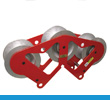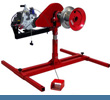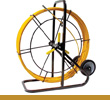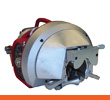
It’s been a busy month: DCD Design have created a new how-to video for the Eagle Cable Lasher, demonstrating some of the features and showing you how to load the lashing wire. (This ties in to next month’s promotion. Subscribe to the mailing list and keep an eye out for updates.)
We put this one together on the workbench and outside on our ‘test line’ to show off the lightweight Eagle. Like the larger Lineman lasher, it uses tension from the lashing wire to drive the drum, not traction on the strand. As long as you’re moving forward, you’re spinning!
In other news, we’ve just finished an intensive four-day basic training for Solidworks 3D software. It’s astonishing what this software can do: if you can sketch it on a napkin at lunch, we can create a 3D model by the end of the day! DCD Design have always been progressive when it comes to listening to our customer’s requirements; now we can assess and turn around a new design faster than ever before.
AND! Direct Horizontal Drilling of Edmonton have been setting up for a river crossing in the neighbourhood: a new gas pipeline is going to be pulled under the Fraser River tonight! Good luck and smooth pulling to them.
The DCD Manufacturing Group had their annual golf tournament on Monday the 5th, to coincide with the Independence Day long weekend. The weather cooperated in the end, and the afternoon got nicer as the strokes added up.
This has become a tradition for DCD Design: to bring together office and shop staff, our vendors, and our associated Group companies to enjoy a team-scramble to the top of the heap! Trophies were awarded, great prizes from our generous vendors were drawn, and we enjoyed dinner and a beverage with the Group in the late-afternoon sun.
For my once-or-twice a year outing, I’m glad to say I only lost one ball – unfairly – up a particularly thick evergreen! Otherwise, we all had an excellent round.
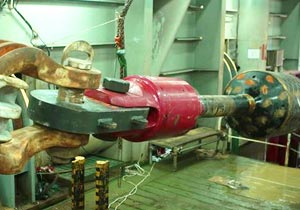
Spent the morning at the foundry, inspecting the cast-alloy clevis ends of the 350 ton and 500 ton swivels, and discussing the method with the foundrymen there. Sand casting has a long history, contributing to the Industrial Revolution and the automotive industry in its formative years – both pivotal events!
DCD Design takes advantage of the efficiency of sand casting to put metal where it’s needed, in the chemistry desired, to gain the properties necessary for the Maxi-DUB swivels to excel in the difficult conditions encountered in directional bore holes.
Castings are poured, chilled, broken out and individually inspected to ensure a quality product, but each casting is unique. The mold is broken every time!
Castings of this size (over 800lb, in some cases) will typically show the pattern of the sand, and perhaps the impression of the chilling blocks and part line. Overall though, the massive castings are homogeneous after heat treatment and benefit from the grain structure imparted by the process.
Dendritic growth and phase transformation are technical terms for it, but imagine ice crystals forming in a complex geometry.
Then imagine a massive, solid piece of alloy steel crystallizing like a snowflake. With some perspective, the old ways are damned impressive!
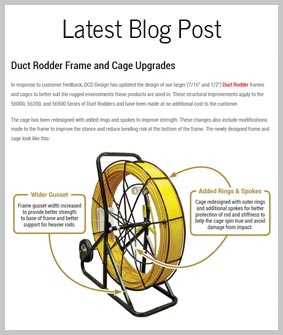
The Mad Ducktor’s production company has been busy producing some new videos this month: we’ve got one on the hand-held ‘Q’ Lasher, one how-to for splicing the DCD duct rod and one incidental video showing a Design moment that let us exhibit some random ingenuity.
Check out the DCD Design channel on Youtube for all the videos, and look for embedded links on the DCD product pages shortly.
We had a busy morning, tensile testing at the material lab: our semi-annual destructive tests of the 00505 Series Line Swivels once again confirmed their rated load capacities. Combined with the full material traceability inherent in our production routine, we can back up our Safe Working Loads.
Have you seen the Line Swivels recently? The batch number and our maker’s mark is now permanently engraved on each Line Swivel. We’re even capable of adding graphics!
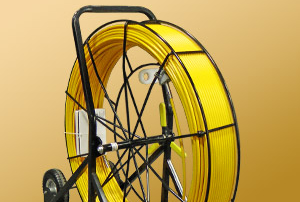
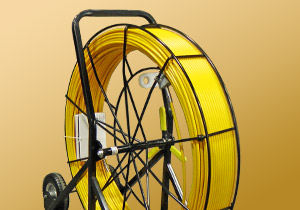
Also new and notable is the 3/16″ Detectable Duct Rod! DCD Design pioneered detectable rod in 2003 with 5/16″ and 7/16″ diameter rods. Now we’ve brought in 3/16″ rod mounted onto the lightweight Reel Rod frame, for quick set-up on shorter runs.
To celebrate, we’re putting ALL the Duct Rodders on sale for the month of June! See our monthly newsletter for all the details, or check the DCD website.
The Mad Duckter is working on a few other things back in the lab, ready to be unleashed in the coming months. Keep an eye open – but remember, The Duckter is no quack!
Watch out for those innerduct pulling eyes – they’ve got sharp teeth!
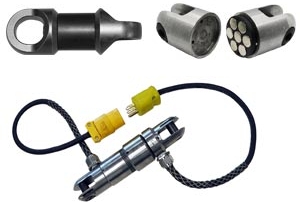
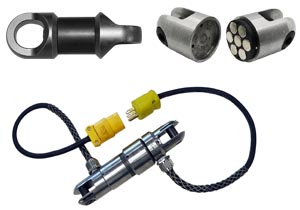
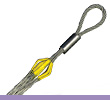
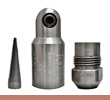
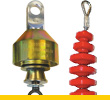
We were making a short video for the various duct pulling tools last week: wire mesh grips, innerduct pulling eyes, the expanding shell pullers and the sealed “bullet” pullers. I was installing them onto typical pieces of duct to compare the time and methods involved.
Getting a Wire Mesh Grip onto a 1-1/4″ duct took some exertion, and then I picked up a 00604-series Innerduct Pulling Eye and threaded that on. (The tapered threads lead to the “carrot” nickname.) Cranked it on tight in a few seconds, but didn’t notice the sharp teeth imprinting themselves into my palm.
Picked up a 00620 Expanding Shell Puller next; slotted that in and cranked the eye tight to engage the shells– and noticed a few drops on the eye of the puller as I put it down again. Kept going, though; only one more puller…
I realized that my hand was shredded as I was socketing the 00650 Sealed Duct Puller over the end of the duct. The o-ring in the outer sleeve sealed down over the end of the duct and the eye was already smeared red. Turned the eye until the shells engaged the inside wall and gave it a tug to show that it had bit into the duct.
And there it is: four options from DCD Design. Each one has advantages, and one of them is particularly sharp! You can see about three bandages on my hand in this second take, and I make sure to mention gloves as an option.
A couple months back, we had Maxi-DUB swivel no. 250102 come in for overhaul. That swivel was 11 years old and we called it The Old Dog.
The Crossing Company of Nisku, Alberta did one better – we have another 250-ton HDD swivel in for service: no. 250101. Built in October of 1997, it’s a full year older than The Old Dog, and I don’t know what we’ll call this one now. “Rusty”, maybe!
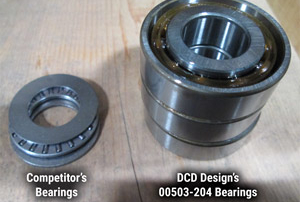
Internally, the swivel’s in good shape. The Crossing Company have taken good care of this tool. A new bearing set, seals and a recut of the API thread, and it’ll be good as new and back in service for a fraction of the replacement cost.
In the 90’s, DCD Design pioneered the Maxi-DUB swivel design with two sizes, the 150-ton & 250-ton. Since then, others have duplicated our patented design while we have steadily added to the line, and now we range from 110-ton through 700-ton swivels (100 – 630 metric tonnes) to fit any big directional drilling rig.
PS. Can you read that nameplate? No, neither can I! But the serial number can be picked out, just barely. Besides that, we had trace marks on the swivel and documentation on file so we could confirm the serial number while servicing the swivel.
We’ve been bouncing around airports for the past couple weeks: Jon visited John Deere Landscapes in Alberta (Calgary and Edmonton) and Ryan’s just back from the NASTT No-Dig show in Chicago.
That’s straight after tour of New Orleans (IEEE Transmission & Distribution), Texas, and Munich (the BAUMA show). The BAUMA show was pretty epic by all accounts, taking over an enormous amount of show space!
But now we’re back and tackling some exciting new prospects. There will be a couple New Product Announcements in the coming months, and take note: there is a new promotion on our 00620/621 Series Duct Pullers and Accessories – both metric and imperial sizing – this month.
I was tensile testing a batch of pins this afternoon and as I watched the load cell count up the pounds to fracture, I was reminded why you should never reuse pins that have previously been in service.
Typically, the load cell shows a linear increase as the crosshead applies strain to the sample. This stress vs. strain relation is constant up to a material’s yield point. At that point, the linear relation breaks down and the material enters the final plastic deformation phase. This phase is just like it sounds – the pin is being stretched like taffy and it won’t recover.
Watching the load cell, you can see the force flat-line while the crosshead is still moving – this is the moment before failure. If you were to stop the test right at this point, the plastic deformation would appear as a thinned-down neck in what was once a straight bar – see the photo. The atomic rearrangements at this point get pretty hectic, as dislocations start skipping through the crystal lattice and hanging up on the grain boundaries!
Similarly if you were using this pin in a breakaway connector: you can see the pin has deformed if it’s been loaded near its maximum capacity. But sometimes, the plastic deformation phase is brief and the pin breaks suddenly. It breaks at the expected load but there’s no plateau on the load cell and the necking is hard to spot.
A visual inspection won’t necessarily show a previously stressed pin and once a pin has entered the plastic deformation phase, it will pick up where it left off and continue to fail in short order. It’s better to start a pull with a new breakaway pin than risk the job.